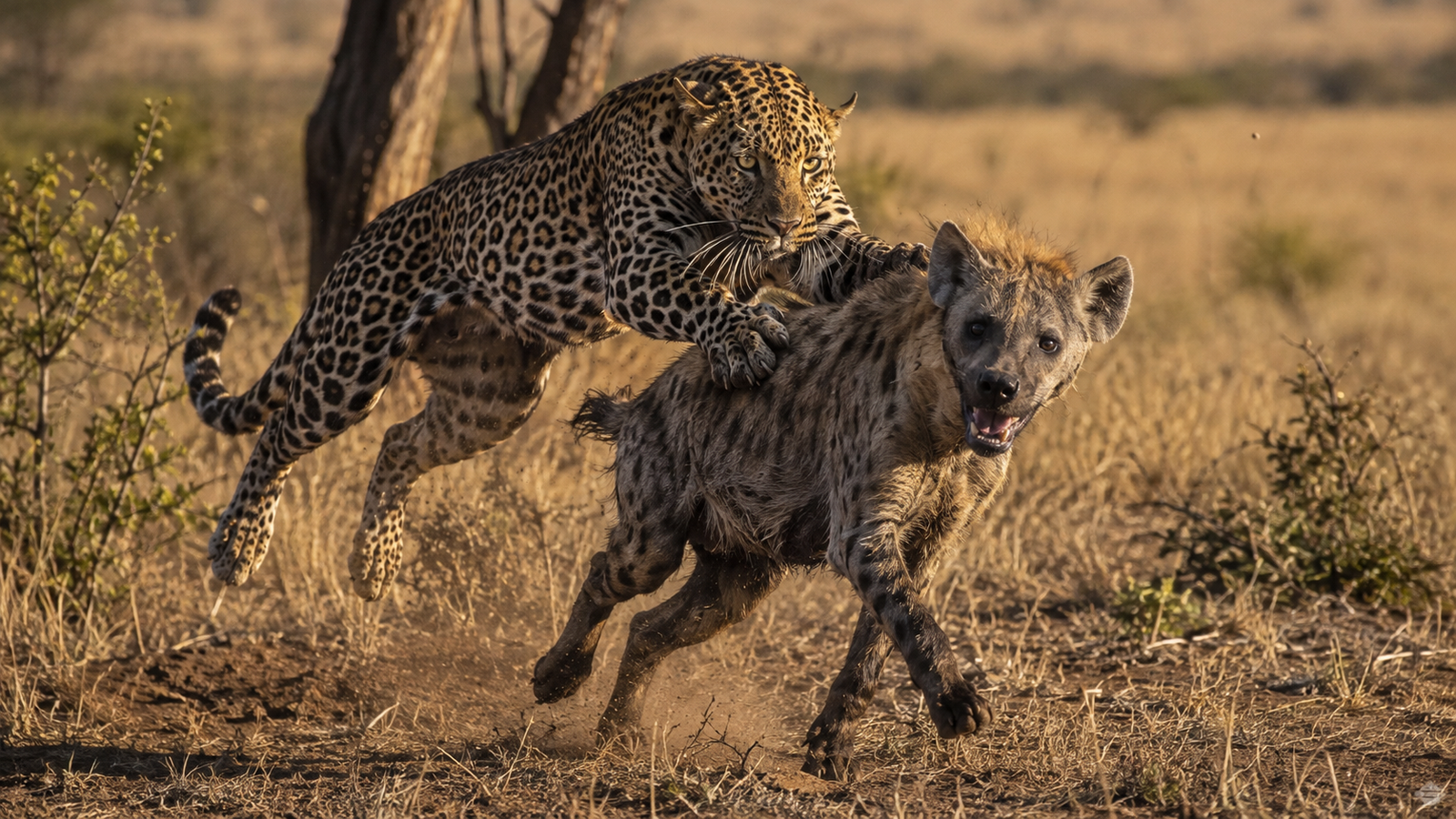
The African bush at dusk is a theater of silence broken by sudden violence. Somewhere in the tall grass, a leopard flattens its body, muscles coiled, eyes locked on a lone spotted hyena picking through the remains of a kill.
What happens next — and who would actually win if these two predators clashed — is one of the most debated matchups in the animal kingdom.
The Ambush
Leopards are solitary, stealth-based hunters. Unlike lions or hyenas, which often rely on numbers, a leopard’s entire hunting strategy is built around getting as close as possible before its target ever knows it’s there.
Using tall grass, rocky outcrops, or the cover of near-total darkness, a leopard can creep within a few meters of prey before launching an explosive charge.
An ambush on a hyena would almost certainly happen for one of two reasons: territorial conflict or a dispute over a carcass.
Leopards and hyenas frequently cross paths because they compete for the same food sources, and hyenas are notorious for tracking leopards specifically to steal their kills.
A leopard that senses an opportunity — a hyena alone, distracted, or caught off guard — may strike first rather than risk losing a meal or being displaced from its territory.
The attack itself would be sudden and brutal. Leopards kill with a precise bite to the throat or the back of the neck, using their powerful jaws to crush the windpipe or sever the spinal cord.
If the ambush is clean and the leopard gets full purchase on a vital area before the hyena can react, the fight could be over in seconds.
Strength and Physical Comparison
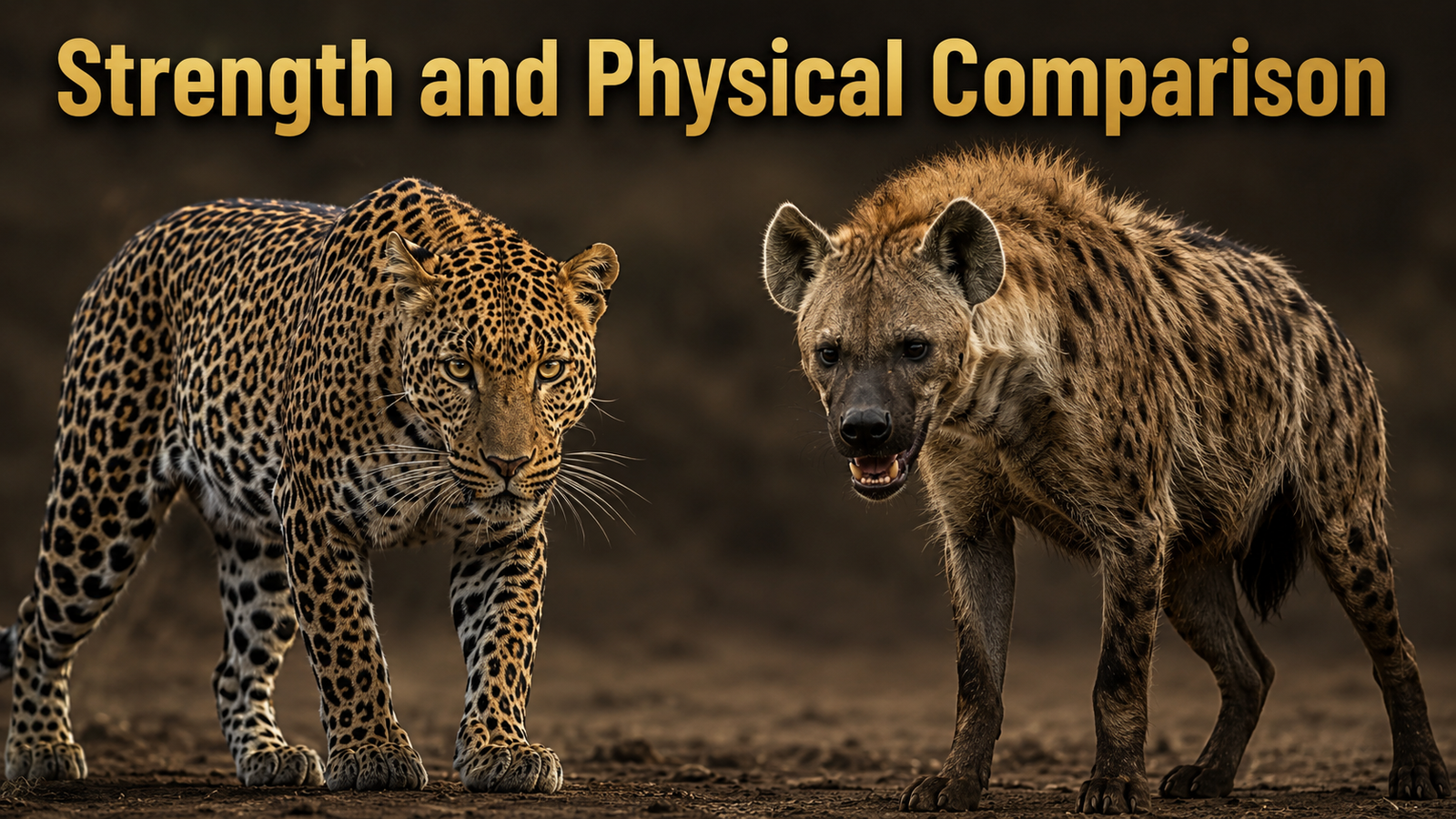
On paper, the two animals are closer in raw physical power than most people assume.
Size and weight: A spotted hyena typically weighs between 40 and 55 kilograms (90–120 lbs), while an adult male leopard usually weighs 30 to 65 kilograms depending on region, with females on the lighter end.
In many parts of Africa, hyenas actually outweigh leopards.
Bite force: This is where hyenas have a clear edge. The spotted hyena possesses one of the strongest bites of any land mammal, estimated around 1,100 psi, powerful enough to crack open bone.
A leopard’s bite is strong for its size, roughly 300 psi, but built more for a precise killing grip than raw crushing power.
Build and agility: Leopards are built for explosive, short-range power and climbing ability.
Their forelimbs and shoulders are disproportionately strong, allowing them to drag prey twice their body weight up trees.
Hyenas, by contrast, have powerful necks, jaws, and stamina suited for endurance and bone-crushing rather than agility or vertical combat.
Claws and weaponry: A leopard’s retractable claws are razor-sharp and used to grip, slash, and pin. Hyenas lack this advantage; their primary weapon is their jaw.
Who Would Win?
In a fair, one-on-one fight where both animals are aware of each other and prepared, most experts and field observations suggest the outcome is genuinely close, but a single adult hyena often has a slight edge in prolonged combat due to raw bite strength and resilience.
However, an ambush changes the equation entirely. Surprise is the leopard’s greatest weapon.
If a leopard successfully catches a hyena off guard and lands a fatal bite to the neck or throat before the hyena can turn and fight back, the hyena’s superior bite force becomes irrelevant — it never gets the chance to use it.
Documented cases and camera-trap footage across Africa have shown leopards successfully killing hyenas, particularly young, injured, or isolated individuals, almost always through ambush rather than head-on confrontation.
Conversely, hyenas that hunt in even small groups of two or three can easily overwhelm and kill a leopard, especially if the leopard is caught in the open without a tree to escape into.
The Real Determining Factor
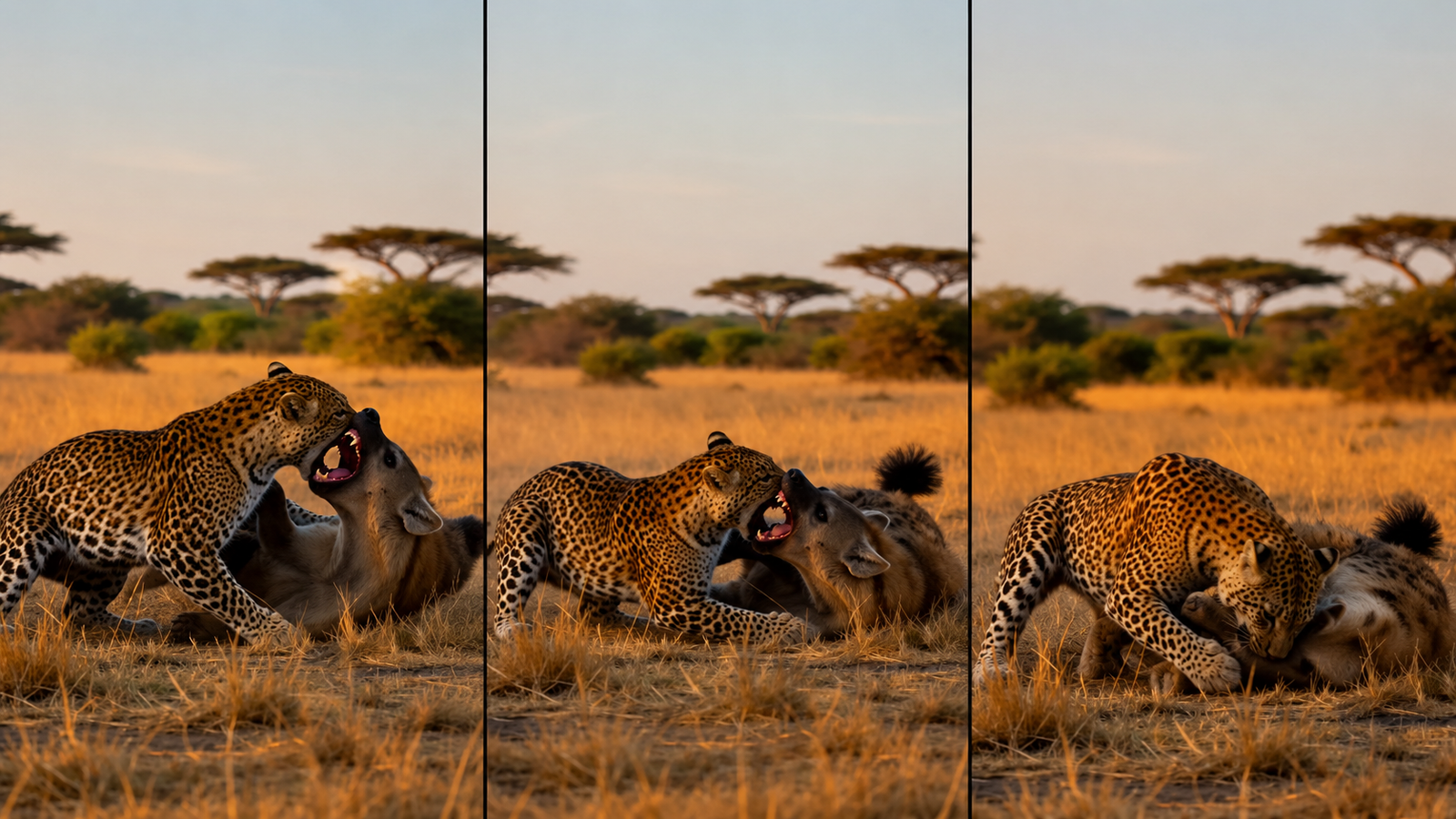
Ultimately, the outcome depends less on which species is “stronger” and more on context: surprise versus preparedness, solitary versus group encounter, and access to escape routes like trees.
A leopard’s ambush is a calculated gamble — devastating when it works, but risky if the strike isn’t clean. In the wild, it isn’t always the strongest animal that survives an encounter, but the one that strikes first and strikes true.