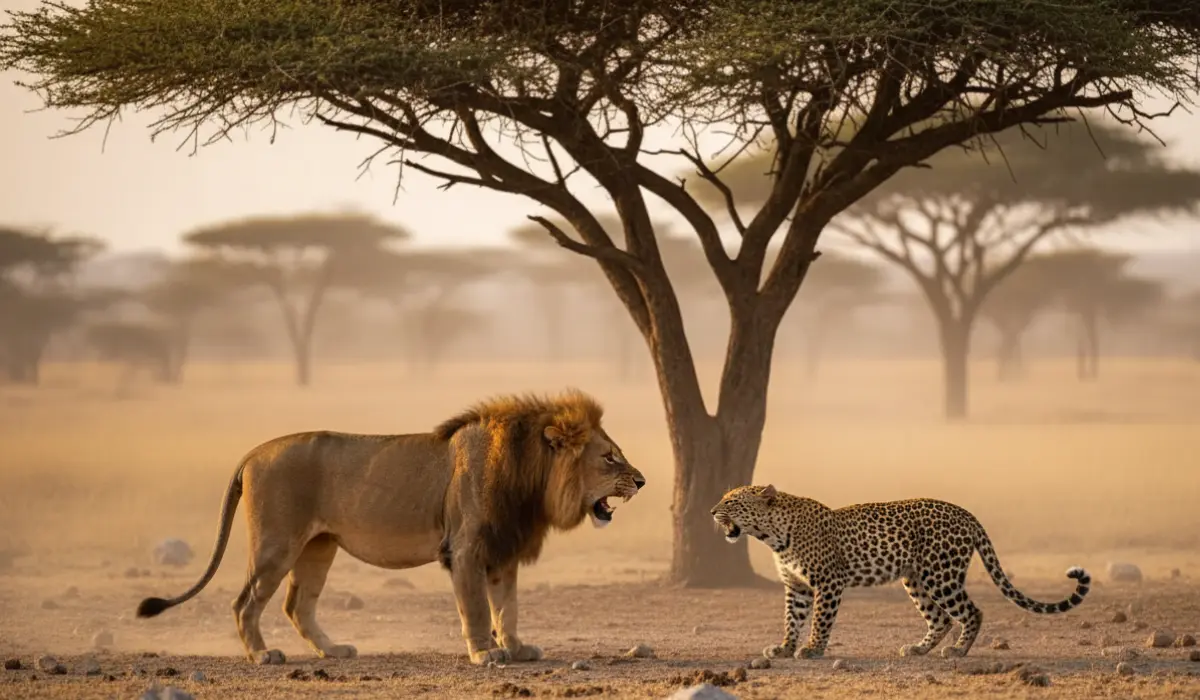
When it comes to big cats, few comparisons spark as much curiosity as the age-old question: Can a leopard defeat a lion in a one-on-one fight?
Both animals are apex predators, powerful and intelligent hunters, but their differences in size, strength, and fighting style make this matchup highly uneven. Let’s break it down, fact by fact, to see how such a confrontation would really play out.
The Size Factor: Power in Proportion
The first and most obvious difference is size. A fully grown male lion can weigh between 400 and 500 pounds, while a male leopard averages 120 to 200 pounds. That’s more than double the weight, and it matters a lot.
In the animal kingdom, size isn’t just about mass; it’s about leverage, reach, and endurance. Lions have larger frames, thicker necks, and more muscular shoulders.
Their skulls are built to deliver devastating bites capable of crushing the windpipe or spine of large prey. Leopards, though muscular and agile, simply don’t have the same physical bulk or raw power to withstand that kind of force head-on.
It’s like comparing a heavyweight boxer to a lightweight champion. The smaller fighter might be faster and more agile, but one clean hit from the heavyweight can end the match in seconds.
Also Read: Why Are Cheetahs Defenseless Against a Crocodile Attack?

Fighting Styles
Lions and leopards have drastically different fighting strategies because they live and hunt in different ways.
Lions are social predators. Males fight frequently, over pride territory, dominance, and mating rights. Their battles are brutal and sustained. A lion’s combat instincts are honed through repeated clashes with rivals, meaning they’re used to facing opponents of equal size and strength.
Leopards, on the other hand, are solitary hunters. They avoid unnecessary fights, preferring stealth, surprise, and escape routes.
Their power lies in their agility and adaptability. A leopard can drag prey heavier than itself up a tree, a feat no lion could match. It strikes fast, kills efficiently, and vanishes before danger approaches.
In a direct confrontation, this agility could give the leopard a few early moves, dodging, swiping, or going for a quick bite. But in a drawn-out fight, that advantage fades quickly against the lion’s brute force and stamina.
Bite Force and Weaponry
Both cats have fearsome weapons, razor-sharp claws, muscular forelimbs, and jaws built for killing. But when you compare the mechanics, the lion dominates.
A lion’s bite force is around 650 PSI (pounds per square inch), while a leopard’s bite is about 500 PSI. That difference may not seem huge, but combined with size and skull structure, it’s decisive. Lions can crush bones that a leopard would struggle with.
Also, lions have a mane, and that’s not just for show. The thick fur around a male lion’s neck offers natural protection during fights.
It cushions blows and reduces damage from bites or claw strikes aimed at the throat, one of the most vulnerable areas in any animal battle. A leopard, with no such defense, is far more exposed.
Environment and Context Matter
Now, in theory, a leopard might win under very specific conditions. If it could ambush a lion, say, leaping from a tree or attacking from behind, it might inflict serious wounds before the lion even reacts. Leopards are stealth masters, capable of silent kills that even large prey never see coming.
But in a fair one-on-one encounter, face to face, with both cats aware of each other, the odds swing almost entirely toward the lion. The leopard’s best survival strategy in such a case wouldn’t be to fight, but to flee.
In the wild, that’s exactly what happens. When lions approach, leopards retreat. They abandon kills, climb trees, or disappear into the bush. It’s not cowardice, it’s survival intelligence. Leopards know that a fight with a lion rarely ends well for them.
Also Read: How to Rescue Your Cattle From an Anaconda Attack
Real-World Encounters
Nature documentaries and field observations confirm this imbalance. In areas where lions and leopards share territory, like parts of Africa, leopards go out of their way to avoid lions.
If a lion discovers a leopard’s kill, it takes over without much resistance. If a confrontation happens, the leopard’s priority is escape.
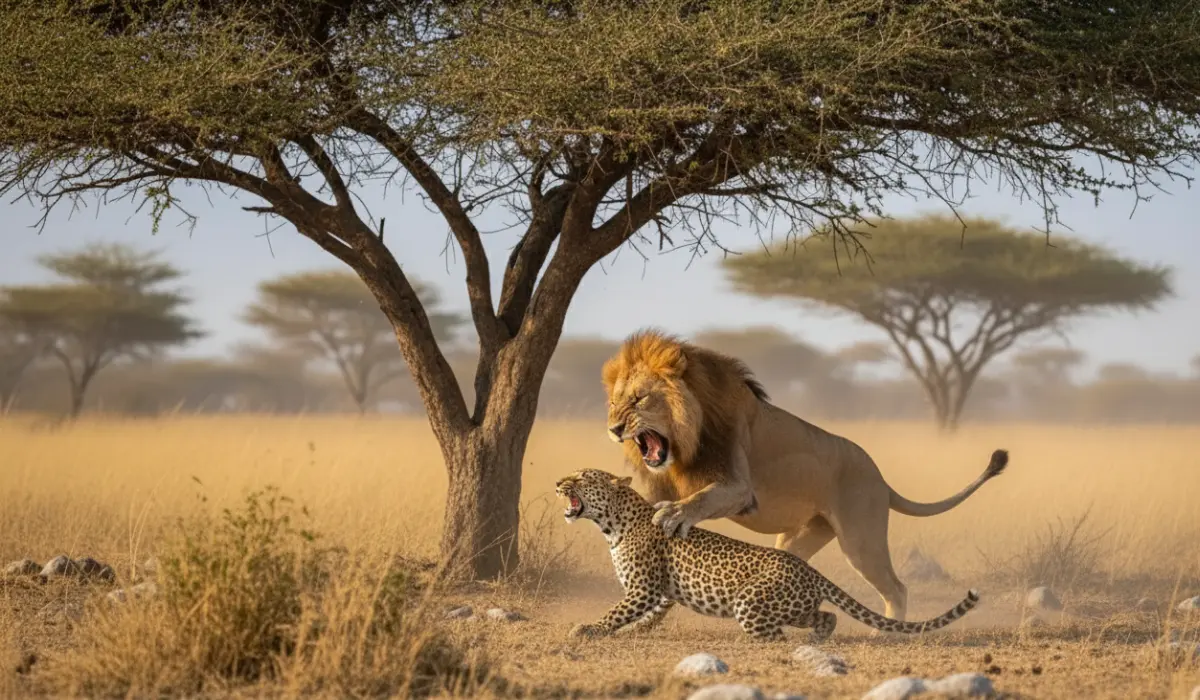
There are rare reports of leopards injuring or even killing young or weak lions, usually through ambush or when defending cubs. But these are exceptions, not the rule. An adult male lion in his prime simply overpowers any leopard foolish enough to stand its ground.
Verdict: The King Keeps His Crown
So, can a leopard defeat a lion in a one-on-one battle?
In almost every realistic scenario, no. The lion’s superior size, strength, and combat experience make it the clear winner. The leopard’s agility and cunning give it the ability to survive, but not to dominate.
If the two ever met in an arena, the outcome would be quick and brutal. The lion reigns supreme among the big cats for a reason, it’s not just a symbol of power; it is power embodied.
The leopard, though, deserves respect for what it is: a master of stealth, grace, and adaptability. It doesn’t need to win such fights because it’s smart enough not to fight them.
In the wild, brains often beat brawn, but when brawn shows up in the form of a lion, even the smartest cat knows when to walk away.