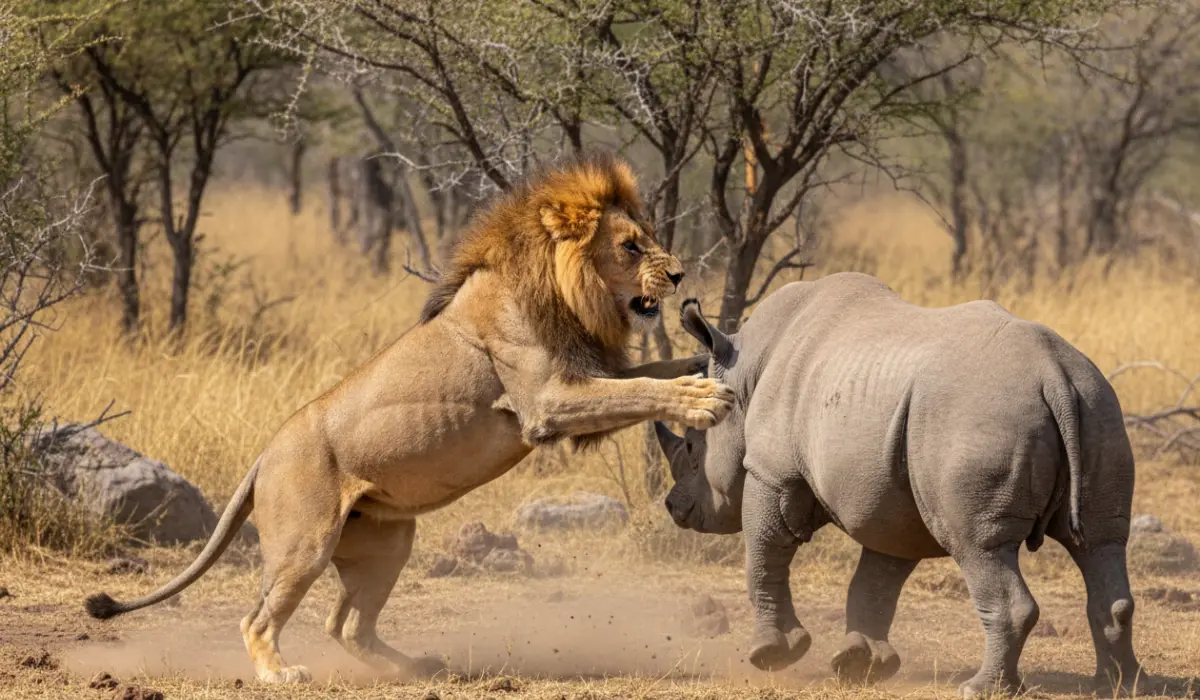
When it comes to the wild, few matchups ignite more curiosity than a rhino versus a lion. Both animals are icons of power, the rhino, a tank with horns, and the lion, a precision predator with claws and cunning.
But if these two were to face off one-on-one, who would actually win? Let’s strip away the myths, weigh the facts, and look at this showdown from nature’s perspective.
Strength vs. Strategy
First, let’s talk stats.
The Rhino:
- Weight: Between 2,000 and 5,000 pounds, depending on the species.
- Armor: A hide that’s 1.5 to 2 inches thick, tough enough to deflect claws, teeth, and even some bullets.
- Weaponry: A massive horn made of keratin (the same substance as human nails), capable of goring, flipping, and crushing.
- Speed: Up to 30–35 mph in short bursts.
The Lion:
- Weight: Around 400 to 500 pounds for a large male.
- Weaponry: Sharp claws, 3-inch canine teeth, and a bite strong enough to crack bones.
- Speed: Up to 50 mph in short sprints, though not for long.
- Strategy: Highly intelligent predator with experience in cooperative hunting and ambushing large prey.
It’s clear from the start: the rhino wins the size and strength category hands down. But lions make their living taking down animals larger than themselves, so it’s not just about raw power, it’s about how that power is used.
Also Read: Can a Grizzly Bear Defeat a Siberian Tiger in a One-On-One Face-Off?
How Lions Hunt Large Prey
Lions don’t usually go after rhinos solo. They’re team players. A pride can coordinate an attack on large prey like buffalo or even young elephants by wearing them down, biting at the legs, and suffocating them once they’re down.
A lone lion, however, doesn’t have that luxury. Without backup, a single lion relies on ambush tactics, surprise, speed, and targeting weak points. Against antelope, this works. Against a rhino? That’s another story.
A healthy adult rhino is simply too big, too strong, and too heavily armored. The lion would have to go for the rhino’s underbelly, eyes, or rear, all hard to reach and dangerous to approach. The moment the rhino turns, the fight becomes life-threatening for the lion.
Rhino’s Advantage
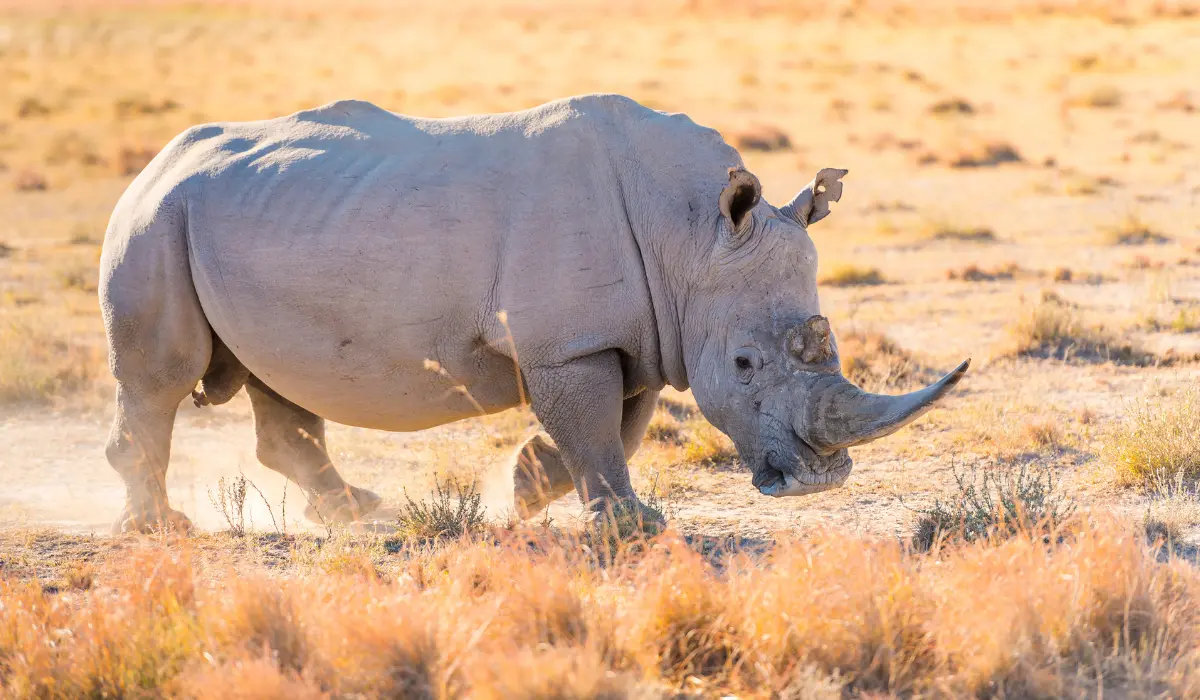
Rhinos are not predators, but they are far from defenseless. They’re territorial, aggressive when provoked, and can charge with devastating force. A charging rhino can crush bones and impale with its horn in one strike.
Their sheer mass is also a weapon. Even if the lion managed to get on the rhino’s back, a near-impossible task, the rhino’s shaking, twisting, or rolling could easily dislodge and injure the lion.
And here’s the key factor: rhinos don’t tire quickly in the same way lions do. Lions depend on quick kills; if the fight drags on, the rhino’s endurance and size become overwhelming advantages.
Real-World Encounters
In real life, adult rhinos and lions rarely fight. They share territories in parts of Africa, but they tend to avoid each other. Lions know a full-grown rhino is bad news. Instead, they’ll target the calves, young rhinos that are smaller, less experienced, and sometimes left unattended.
There are reports and footage of lions attempting to attack adult rhinos, usually in desperate situations. Almost every time, the lion retreats. A rhino’s charge can scatter an entire pride. The only rhinos that fall to lions are sick, injured, or too old to fight back.
Hypothetical One-on-One Battle
So, let’s say we force the scenario: one healthy adult lion versus one healthy adult rhino, in open terrain, no surprise attacks, no pride backup.
Here’s how it would likely play out:
1. The lion circles, looking for a weak spot, maybe trying to get behind the rhino.
2. The rhino holds its ground, alert, snorting, and ready to charge.
3. The lion tests the waters with a quick feint, maybe a leap to the side, or a swipe.
4. The rhino charges, and the fight is effectively over.
A rhino’s charge is like getting hit by a moving truck with a spear on the front. The lion would either have to dodge perfectly or get seriously injured. Even a glancing hit could break ribs or legs. Once wounded, the lion’s odds drop to zero.
The only way the lion could win is through an unlikely combination of luck, precision, and patience, perhaps finding a blind spot or exploiting a wound. But against a healthy adult rhino, it’s next to impossible.
Final Verdict
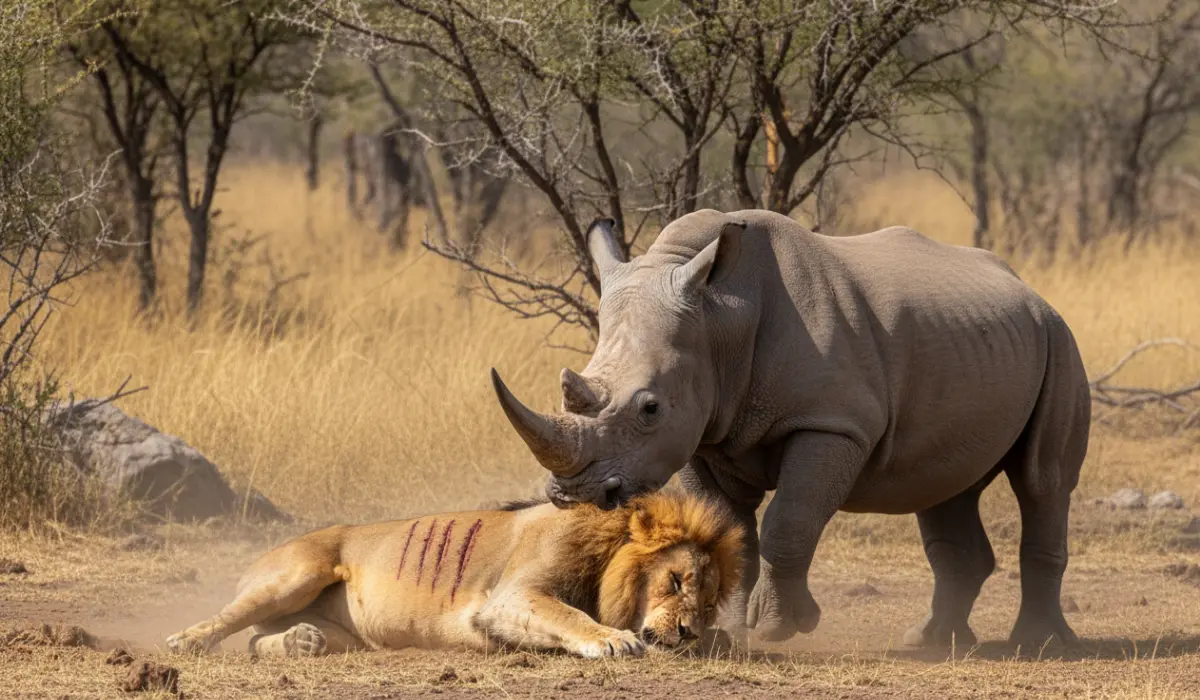
In a one-on-one fight, the rhino dominates. Its size, armor, and sheer power make it nearly untouchable by a single lion. Lions are master strategists, but even strategy has limits when faced with a living tank.
Nature’s balance keeps both animals at the top of their own lanes: lions as apex predators, rhinos as unstoppable forces of defense. In a head-to-head duel, the rhino wouldn’t just survive, it would win decisively.