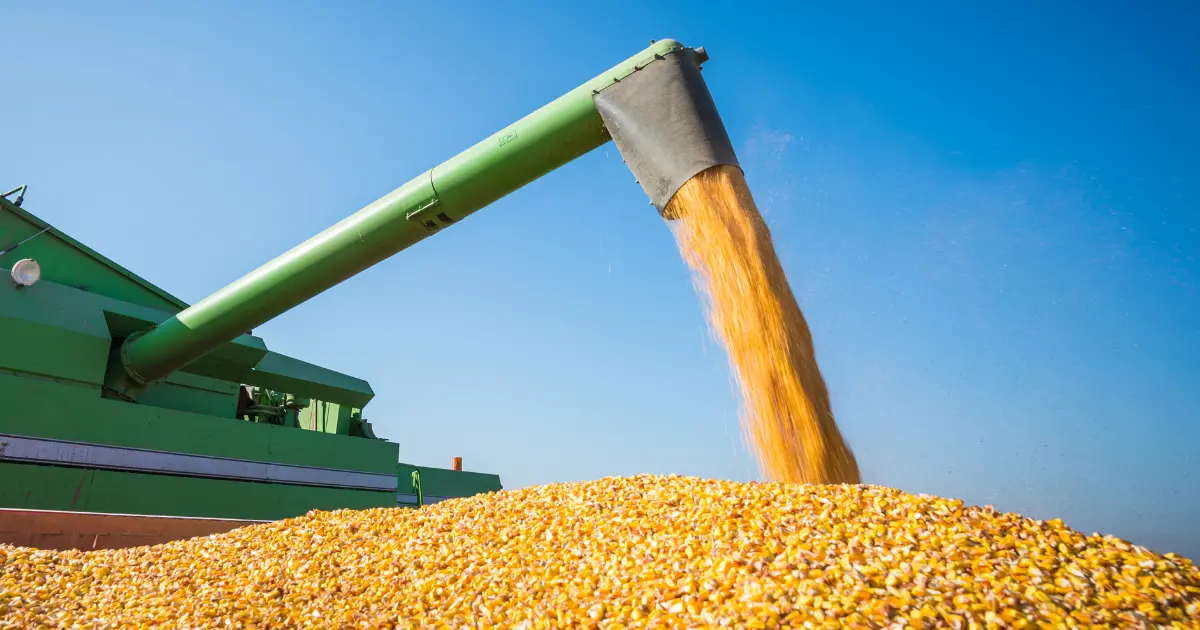
As combines roll across the Midwest this fall, farmers are finding that local corn markets are not moving in lockstep with national futures.
While Chicago futures prices draw headlines, it is the cash basis, the difference between local cash bids and futures contracts, that dictates real-world decisions for growers facing one of the largest harvests on record. And this year, those local markets are sending mixed, and sometimes surprising, signals.
At issue is how the grain supply chain is absorbing a massive crop. The U.S. Department of Agriculture expects record corn production nationwide and historically high soybean output, filling nearly 86% of available storage capacity.
That is slightly less constrained than last year, but tighter than average for the decade. Where crops end up, and how they are transported, is proving just as important as how much was grown.
Local Dynamics Drive Divergent Outcomes
In the eastern Corn Belt, farmers in Indiana are staring down a weaker-than-expected basis. Central Indiana corn is trading nearly 30 cents lower than forecasts suggested.
By contrast, Iowa and Nebraska, two of the region’s largest producers, are experiencing markets much closer to projections. In north-central Iowa, cash bids recently hovered about 44 cents below December futures, nearly identical to pre-harvest expectations. Central Nebraska was also near forecast, trading around 43 cents under futures.
Kansas, however, is behaving differently. Despite a smaller crop this year compared to 2024, cash prices there remain unexpectedly soft. That divergence highlights how local demand, transportation costs, and storage limitations combine to shape basis values in ways that don’t always follow straightforward supply-and-demand logic.
Also Read: Watch: Wexford farmer named Teagasc FBD Sustainability Award winner
Animal Feed Demand Slips in the East
One reason for Indiana’s weaker bids lies hundreds of miles away in the Southeast. Much of Indiana’s grain doesn’t stay local, it moves by rail and truck to feed livestock and poultry operations in states like North Carolina and Georgia.
But demand in those regions has faltered. Government reports showed hog inventories in North Carolina down 4% from a year ago, while poultry slaughter in August also declined. With fewer animals to feed, corn consumption has dipped, pulling down bids in the eastern Midwest.
Ethanol plants are not filling the gap. U.S. gasoline consumption remains sluggish, limiting margins for biofuel producers. Without strong demand from feedlots or ethanol, Indiana’s grain handlers are leaning on exports.
But river transport is unreliable this season. Low water on the Mississippi has triggered draft restrictions, making barge traffic more costly and less efficient. That bottleneck has choked off one of the region’s most critical outlets.
Kansas Markets Face Rail Congestion
In Kansas, the problems appear differently, but they lead to a similar outcome: weaker cash markets. Unlike eastern states that rely on river shipping, western grain shippers move their crops via rail to Pacific ports.
This fall, railcars have been expensive and hard to secure, in part due to carriers pushing to meet tariff deadlines. With transportation costs climbing, buyers have backed away, and the local basis has eroded.
There may be relief in sight. Analysts suggest that congestion could ease in the next month or two as trade logistics stabilize. If that happens, shippers may be able to increase bids, though whether domestic or export buyers step in to absorb additional corn remains uncertain.
Storage Strategies and Market Risks
For many farmers, the current weakness in basis is an incentive to hold grain back rather than sell into a soft market. Much of the crop is being funneled into on-farm bins or commercial elevators, often without price protection. That decision leaves growers exposed to future swings, for better or worse.
Commercial grain handlers, by contrast, operate with strict hedging strategies. They are prohibited from speculating outright on price direction, instead locking in margins through futures contracts.
Current spreads between December 2025 and July 2026 futures narrowed last week, strengthening nearly six cents. Some traders view this as a signal that the harvest may not be as overwhelming as first feared.
Still, history suggests caution. In four out of five years, those spreads weaken rather than tighten, reducing carry opportunities. For farmers, the bet is whether holding grain in storage will pay off with a stronger basis in the spring, a pattern that has often repeated itself but is never guaranteed.
The Bigger Picture
This year’s corn market is a reminder that local conditions, not just national headlines, shape farm-level economics. Storage space, river levels, rail costs, and feed demand all interact with global supply and demand in ways that can leave one state flush with bids and another struggling to move grain.
As the 2025 harvest accelerates, producers will continue to balance the temptation to wait for stronger prices with the realities of storage costs and cash flow needs. If history is any guide, basis levels could improve in the months ahead.
But for now, the Midwest’s corn economy remains a patchwork of strong crops, stressed transportation systems, and uneven demand, proof that in agriculture, all markets are indeed local.