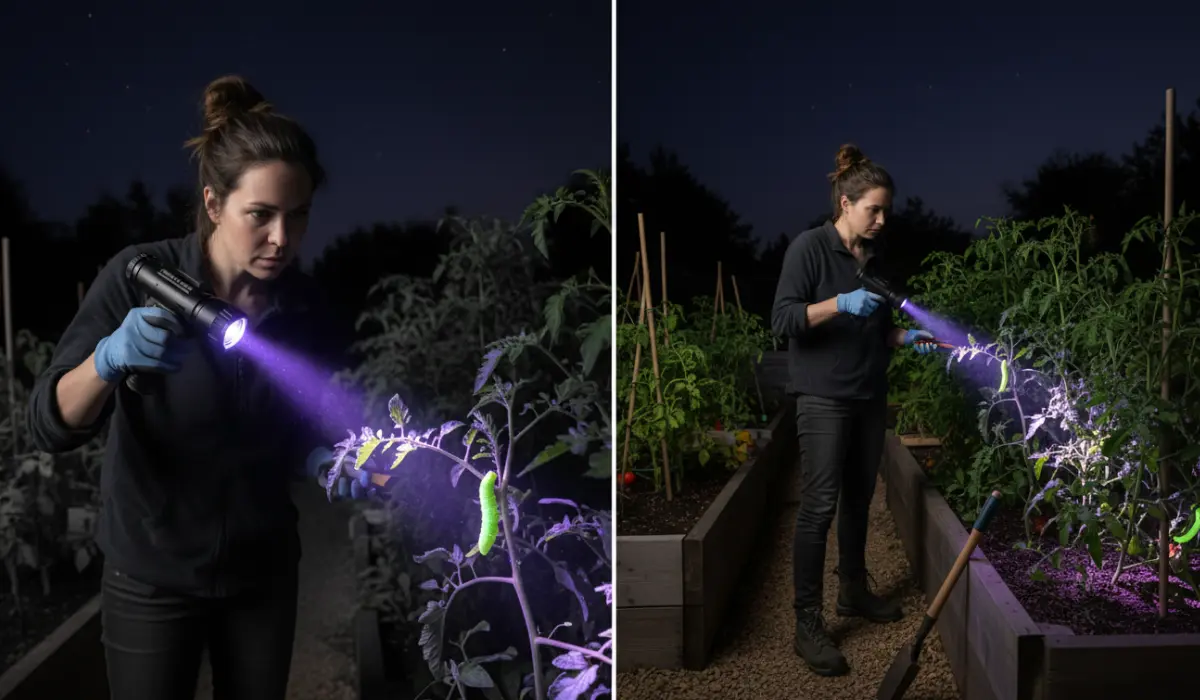
Every gardener has that one pest that keeps them awake at night, and for me, it’s the tomato hornworm. These large, green caterpillars have an uncanny ability to strip a tomato plant bare in a matter of hours.
The problem is they’re masters of disguise, blending perfectly into stems and leaves.
For years, I struggled to spot them in daylight until I discovered one of the simplest, most effective tricks in my gardening toolbox: using a UV flashlight.
With it, hornworms almost glow in the dark, turning the nightly hunt into both a practical solution and a strangely satisfying ritual.
What Are Tomato Hornworms?
Tomato hornworms are the larvae of the sphinx moth, and they’re among the most destructive caterpillars in the vegetable garden.
They can reach up to four inches long and feed voraciously on tomato, pepper, and eggplant leaves. Left unchecked, they can weaken a plant to the point that it can no longer bear fruit.
Their size alone should make them easy to spot, but their green coloring is almost identical to the stems they cling to.
What makes hornworms particularly frustrating is how quickly they can cause damage. I’ve gone to bed with healthy-looking plants and woken up to stalks stripped bare, blossoms clipped off, and fruits chewed into.
Their stealth comes from not only their color but also their tendency to feed on the undersides of leaves or deep within the plant canopy.
By the time most gardeners realize they have an infestation, the plants are already showing serious stress.
Over the years, I’ve learned that hunting hornworms during the day can feel like searching for a needle in a haystack. They remain still, often curling around stems to break up their outline.
My first seasons of tomato gardening were filled with frustration and losses until I realized I needed to outsmart their camouflage. That’s when I discovered the unusual but highly effective tool: the UV flashlight.
Also Read: Eco-Friendly Ways to Get Rid of Earwigs from Your Garden
Why UV Light Works
The magic of the UV flashlight lies in the way hornworms fluoresce. Under ultraviolet light, their bodies reflect a bright greenish glow that stands out starkly against the dark leaves and stems.
It’s almost as if someone had highlighted them with a neon marker. This fluorescence isn’t unique to hornworms, but it’s especially pronounced, making them easy to identify even when they’re deep within the foliage.
In daylight, hornworms rely on their camouflage to avoid predators. Their color matches the plant so well that even birds often miss them.
But at night, when the UV light hits them, they lose their invisibility cloak. It transforms the frustrating chore of hornworm hunting into something almost effortless. With a single sweep of the light, I can spot what would have taken me half an hour to find during the day.
I’ll never forget my first UV hunt. I had spent the afternoon combing through plants with little success, only to find half a dozen hornworms glowing like lanterns after sunset.
It was a revelation. Since then, my UV flashlight has become as essential a gardening tool as my pruning shears or watering can.
Choosing the Right UV Flashlight
Not all UV flashlights are created equal, and that’s something I learned quickly. The key factor is wavelength. A flashlight around 365 nanometers tends to work best, producing a strong glow from the hornworms while still being comfortable to use.
The cheaper 395-nanometer models will work too, but the fluorescence isn’t always as striking. Investing in a higher-quality light pays off in easier hunting and longer-lasting equipment.
Durability also matters. I’ve had lights that gave out after a single season because they weren’t designed for outdoor conditions. A sturdy casing, weather resistance, and reliable battery life are must-haves.
I usually choose a flashlight that’s compact enough to carry in one hand while I move leaves with the other. Rechargeable batteries are another feature I’ve come to appreciate, especially during peak hornworm season when I use the light several nights a week.
Of course, safety is important. UV light can be harmful to the eyes if used improperly, so I always avoid shining it directly at my face or anyone else’s.
Some gardeners even prefer wearing UV-protective glasses during hunts, which is never a bad idea. With the right flashlight in hand, the hunt becomes less about struggling and more about strategy.
Preparing for the Hunt
Timing is everything when it comes to hunting hornworms. I find that the best window is just after dusk when the garden is dark enough for the fluorescence to stand out, but early enough that I can still work comfortably.
Some nights I also hunt early in the morning before sunrise, which works equally well. The key is darkness, hornworms won’t glow in daylight.
Preparation also makes a big difference. Before I head out, I clear walking paths through my garden so I’m not stumbling around with a flashlight in one hand.
I keep gloves ready, since hornworms can feel unpleasant to handle, and a container to collect them in. Some gardeners prefer using jars with lids, while others drop them into a bucket of soapy water.
I’ve tried both, and either works fine depending on what you plan to do with them afterward.
I also like to move quietly and deliberately. The stillness of the evening garden allows me to focus and notice subtle movements in the plants.
Sometimes I’ll spot a hornworm before even turning the light on, simply because I’ve slowed down enough to really look. By combining good preparation with patience, the hunt becomes both efficient and strangely meditative.
The Actual Hunting Process
When I begin scanning with the UV flashlight, I hold it close to the plants, moving slowly from top to bottom. The hornworms usually reveal themselves within seconds as bright, glowing bodies against the shadowy leaves.
It never ceases to amaze me how obvious they look under UV when they had been completely invisible in daylight.
Hornworms often congregate on the undersides of leaves or near the mid-sections of plants where foliage is thickest. I make sure to check stems carefully, as they sometimes wrap around them.
Their glowing bodies make them easy to distinguish from other insects, though occasionally a leaf vein or spot of residue might reflect light in a similar way.
Experience quickly teaches you what a hornworm is and what isn’t.
Once I’ve spotted a hornworm, I gently pull it off the plant, usually with gloves on. They cling tightly, but a slow, firm tug does the job.
From there, I decide whether to save it as a treat for chickens, relocate it, or dispose of it entirely. The process is surprisingly quick, most nights, I clear a dozen or more hornworms in under twenty minutes.
What to Do with the Hornworms After Capture
Deciding what to do with the hornworms after catching them is often a personal choice. Many gardeners drop them into soapy water, which kills them quickly.
This method is efficient and ensures they won’t return to your plants. It’s what I relied on in my early gardening years when I felt more frustrated by the damage they caused.
Over time, I realized hornworms don’t have to go to waste. They make an excellent protein-rich treat for chickens, ducks, or even certain reptiles.
When I give a freshly caught hornworm to my flock, it’s gone in seconds. This way, the pests I remove from the garden turn into food for another part of my homestead. It’s a satisfying cycle of reclaiming value from something destructive.
Some gardeners choose to relocate hornworms, though this can be tricky. Unless you move them far from your tomatoes, they’ll likely find their way back.
I generally reserve relocation for parasitized hornworms, those carrying the white cocoons of beneficial wasps. Leaving or relocating those actually helps reduce future hornworm populations naturally.
Also Read: How to Identify Common Garden Pests By Their Leaf Signature
Preventing Future Infestations
As effective as UV hunting is, prevention is always better than cure. One of my favorite strategies is crop rotation. By moving tomatoes to a different bed each year, I disrupt the life cycle of hornworms that might overwinter in the soil.
Tilling in the fall also helps expose pupae to predators and the elements, reducing populations the following season.
Companion planting has also become a core part of my approach. Herbs like basil, dill, and marigold not only attract beneficial insects but also deter hornworm moths from laying eggs nearby.
I’ve noticed that when I interplant these alongside my tomatoes, the number of hornworms I find drops significantly. It’s not foolproof, but it makes a noticeable difference.
Finally, I encourage natural predators. Ladybugs, lacewings, and especially parasitic wasps are invaluable allies in keeping hornworm numbers down.
I avoid broad-spectrum insecticides for this reason, focusing instead on creating a balanced ecosystem in my garden. By combining these cultural practices with UV hunting, I keep my tomato plants thriving without heavy reliance on chemicals.
FAQs
A flashlight around 365 nm works best. Cheaper 395 nm lights will still work, but aren’t as effective. No, hornworms aren’t dangerous, though they can feel unpleasant. Wearing gloves makes handling easier. Hornworms also feed on peppers, eggplants, and potatoes, other members of the nightshade family. Can I use any UV flashlight, or does it need a specific wavelength?
Are hornworms harmful to touch with bare hands?
What crops besides tomatoes can hornworms damage?