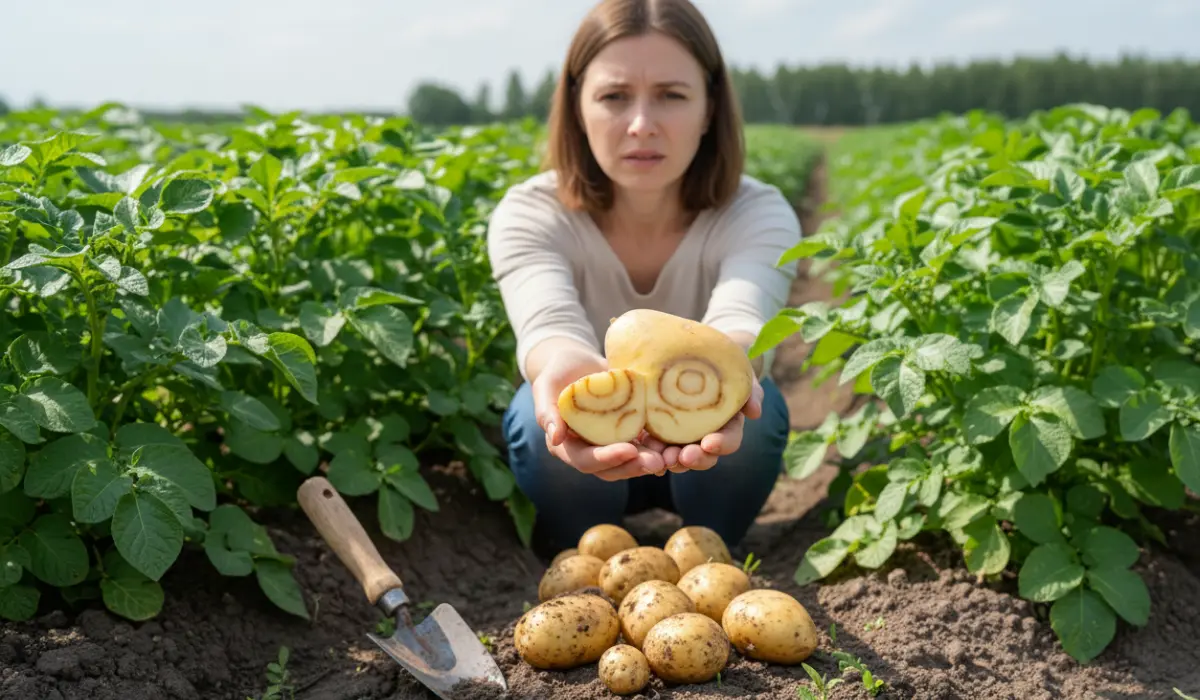
Potato Virus Y (PVY) is one of the most destructive diseases I face in potato production, and over the years, I’ve learned that managing it requires patience, strategy, and discipline.
Unlike many diseases, PVY isn’t something I can just spray away. It’s a viral problem, and that means the solution has to be layered, starting from the seed, extending into the field, and relying on vigilance throughout the season.
In this guide, I’ll share the full approach I use to treat and control PVY, not just quick fixes but sustainable methods that keep fields productive over time.
What is Potato Virus Y (PVY)?
Potato Virus Y is a member of the potyvirus family, which includes several major crop diseases. What makes PVY particularly harmful is that it doesn’t always show obvious symptoms at first, yet it can slash yields and degrade tuber quality significantly.
The damage isn’t only cosmetic; PVY affects both the marketability and storability of potatoes, which translates directly into financial losses.
The virus comes in different strains, such as PVY^O, PVY^N, and PVY^NTN. Each behaves differently, with some causing only mild mosaic leaf patterns while others lead to necrosis and severe tuber damage.
I’ve seen fields with mixed infections where identifying the specific strain was nearly impossible without lab testing. This complexity makes it essential to think of PVY as a moving target rather than a single, predictable disease.
Symptoms vary, which complicates diagnosis. Leaves may show mottling, yellow streaks, or curling, while plants may appear stunted.
In some cases, infected plants still look reasonably healthy but pass the virus on to the tubers, which then spread infection when planted the following year.
For me, that hidden transmission is what makes PVY most dangerous, it’s always working behind the scenes.
Also Read: How to Treat Fusarium Wilt in Tomato Plants
How PVY Spreads
One of the first lessons I learned is that PVY spreads primarily through aphids. These small insects feed on the sap of potato plants and can transmit the virus in seconds.
The challenge is that PVY is transmitted in a “non-persistent” manner, meaning aphids pick it up and pass it on almost instantly, even before insecticides have a chance to kill them. That’s why relying solely on spraying never works for me.
Seed tubers are another major culprit. If I start with an infected seed, the problem is already in the field before aphids even arrive. I’ve had years where I thought I had controlled vectors well, but because the seed wasn’t clean, PVY still established itself.
The seed pathway is often overlooked, but in my experience, it’s the single most critical factor to address first.
Mechanical transmission adds another layer. Tools, hands, and even field machinery can carry the virus from one plant to another.
When neighboring fields are involved, the risk multiplies. It’s taught me that managing PVY isn’t just about what happens in my own field, it’s also about being aware of what’s happening in the larger farming community.
The Importance of Seed Health
Starting with virus-free seed is non-negotiable for me. Certified seed programs exist for a reason, and I always make sure my seed lots have been indexed and tested.
Even when the upfront cost is higher, it saves me much more in lost yield and management costs down the line. A single infected seed tuber can set off a chain reaction across an entire field.
I don’t just trust labels blindly. Whenever possible, I send samples for independent testing, especially if I’m expanding seed stock for future use.
ELISA testing and now rapid diagnostic kits make this process easier and more affordable. Taking these steps gives me confidence that my crop starts on a solid footing.
Seed rotation is another practice I follow religiously. I never recycle seed from fields with any PVY history, no matter how minor it seemed.
Once PVY establishes in a line of seed, it can build year after year until the problem becomes unmanageable. By sourcing fresh certified seed regularly, I break that cycle and keep my fields clean.
Vector (Aphid) Management Strategies
Because aphids spread PVY so quickly, I’ve learned that insecticide sprays only play a minor role. They reduce overall aphid populations, but they can’t stop the initial transmission.
That’s why I combine chemical control with other strategies that interfere with how aphids behave in the field.
Reflective mulches, for instance, make it harder for aphids to locate potato plants. I’ve also experimented with border crops, which act as a barrier and intercept aphids before they reach potatoes.
These non-chemical tactics don’t replace insecticides, but together they add up to a stronger defense system.
Monitoring is just as important as action. I scout regularly, use sticky traps, and pay attention to regional aphid alerts. Knowing when migrations are likely helps me time interventions better.
Instead of reacting blindly, I can adjust my strategy to the actual pressure in the field. This proactive approach saves both money and crop quality.
Cultural Practices That Reduce PVY Pressure
Field management makes a huge difference in keeping PVY under control. Crop rotation is key; planting potatoes too frequently in the same field builds disease pressure.
By spacing out potato crops, I reduce the reservoir of infected plants available for virus carryover.
Roguing is another practice I never skip. Whenever I spot suspicious plants, I remove them immediately, even if it’s only a few. Leaving infected plants in the field is like leaving an open door for PVY to spread. I also sanitize equipment between fields to prevent mechanical transmission.
Planting dates also play a role. I sometimes adjust schedules to avoid peak aphid flights, which reduces exposure during the most vulnerable growth stages.
Managing canopy structure by balancing nitrogen inputs also discourages aphid colonization, since dense, lush canopies tend to attract them. These cultural tweaks may seem small, but together they significantly cut PVY pressure.
Resistant and Tolerant Varieties
Breeding has given us new tools against PVY. Some varieties show strong resistance, either by limiting virus multiplication or by expressing hypersensitive responses that stop infection early.
Others are tolerant, meaning they can carry the virus without severe yield loss. Both options are useful, depending on production goals.
I’ve grown resistant varieties in fields with high PVY pressure, and they held up far better than susceptible types. Still, no variety is invincible.
Resistance can break down over time as new virus strains emerge, so I treat resistance as one layer of defense, not a standalone solution.
Balancing resistance with market demands can be tricky. Buyers often want specific varieties, which may not always be the most resistant.
In those cases, I weigh yield potential against disease risk. Sometimes it’s worth sacrificing a bit of market preference to ensure healthier, more sustainable crops.
Also Read: Grow These 10 Herbs to Naturally Protect Your Plants from Pests
Advanced Approaches
Technology has changed how I deal with PVY. On-site diagnostic kits, ELISA tests, and PCR labs allow me to confirm infections quickly, rather than relying on symptoms alone.
This speed helps me make better decisions about roguing and seed selection.
Precision agriculture tools are another breakthrough. Drones and satellite imagery can spot subtle changes in crop vigor that may indicate early PVY infection.
By identifying hotspots, I can target interventions rather than treating entire fields unnecessarily.
Looking ahead, genetic engineering and RNA interference (RNAi) offer promising new strategies. These technologies could eventually deliver potato varieties that block PVY at the molecular level.
While not yet mainstream, I believe they’ll become an essential part of PVY management in the future.
FAQs
No, sprays don’t kill viruses. They only reduce aphid populations, which indirectly lowers transmission. Certified seed programs test for PVY, but I recommend additional lab or rapid diagnostic testing for assurance. No, PVY needs living host tissue to survive. It doesn’t persist in bare soil, but volunteer plants can harbor it. PVY is viral and spread mainly by aphids and seed, while late blight is fungal-like and managed through fungicides and weather-based models. Are chemical sprays effective against PVY itself?
How do I know if my seed is PVY-free?
Can PVY survive in soil without potatoes present?
What’s the difference between PVY and late blight in terms of management?