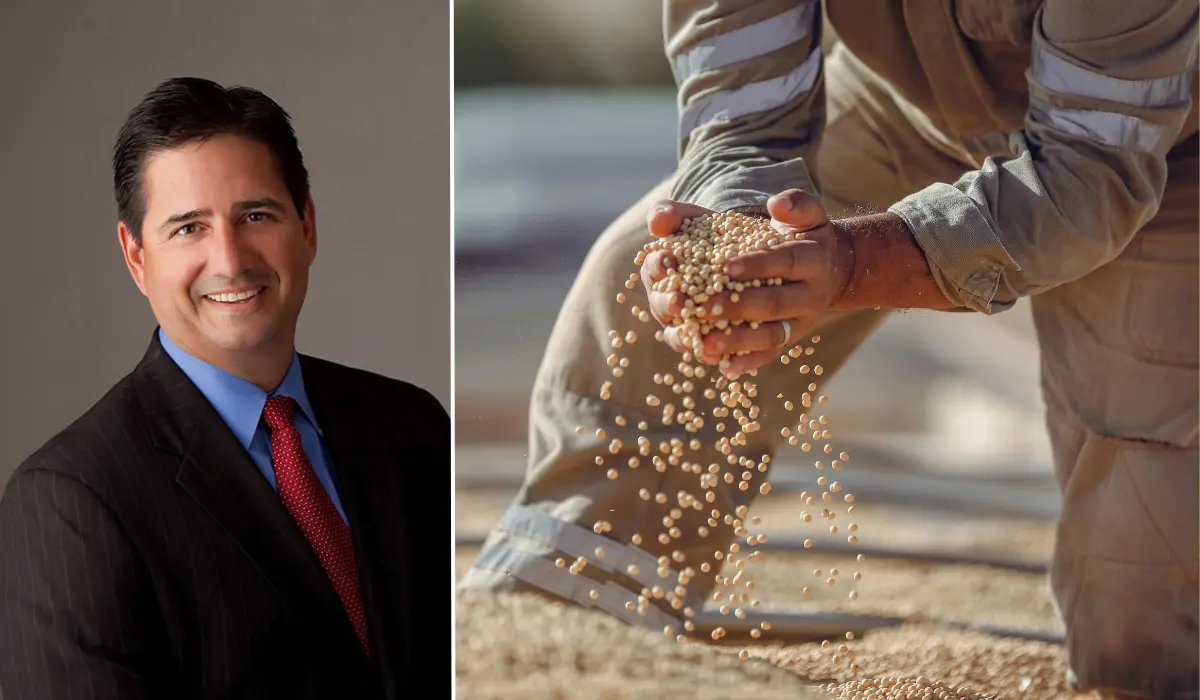
Illinois Agriculture Director Jerry Costello is raising alarms over the steep decline in U.S. soybean exports to China, warning that the downturn could deal a severe financial blow to one of the nation’s most important agricultural states.
Speaking this week, Costello said the near absence of soybean sales to China, the world’s largest consumer of the crop, poses serious risks for Illinois farmers who have long depended on strong overseas demand to keep their operations profitable.
China’s Role in Illinois Agriculture
Illinois ranks among the top U.S. states for soybean production, and China has historically been its most significant customer. The state’s agricultural exports reached $13.7 billion in 2023, with nearly $1 billion of that tied to soybean shipments to China.
That reliance underscores just how much is at stake as sales dwindle.
“Farmers here count on a stable relationship with China,” Costello said, emphasizing that Illinois growers feel the effects of trade disruptions more acutely than many other states because of their high export volume.
Lessons From Past Tariffs
Costello drew a parallel to the trade conflict of 2017–2018, when tariffs imposed between Washington and Beijing sharply curtailed soybean shipments.
Before the tariffs, Illinois exported roughly $1.3 billion worth of soybeans to China in 2017. Just a year later, after retaliatory tariffs took effect, that figure collapsed to $116 million, an eye-popping $1.2 billion drop.
For Illinois farmers, the current slowdown is a haunting reminder of those years, when storage bins filled up with unsold grain and local economies suffered.
Limits at the State Level
While federal policies drive the broader trade environment, Costello said Illinois cannot simply sidestep tariffs or international disputes. Instead, the state is focusing on what it can control: strengthening relationships with current partners and seeking new ones.
“Our role is making sure buyers know Illinois farmers are ready to do business,” he explained. “We can’t dictate tariffs, but we can ensure our products remain competitive and our reputation stays strong.”
Expanding Global Outreach
One of the tools Illinois relies on to maintain and grow export opportunities is the bi-annual Illinois Grain Tour. The event brings trade delegations from across the globe to meet directly with farmers, processors, and exporters in the state.
This week, delegations from China, Vietnam, Egypt, and several other nations are in Illinois as part of the latest tour. The goal, Costello said, is to showcase the state’s agricultural capacity while forging new contracts.
The tours have delivered tangible results. In 2022, agreements struck during the event generated about $129 million in business. Last year, that figure rose to $159 million, marking a $30 million increase.
Costello said those numbers prove the importance of face-to-face engagement in keeping Illinois grain competitive in international markets.
Economic Stakes for Farmers and Beyond
Soybeans are not just a cornerstone of Illinois agriculture, they are vital to the state’s broader economy. The crop supports thousands of farming families, provides raw materials for animal feed and biofuels, and sustains rural communities that depend on farm income.
A downturn in exports to China not only threatens farm revenue but also ripples through related industries, from shipping and logistics to equipment sales. For small towns where agriculture is the economic backbone, the impact could be especially acute.
Navigating an Uncertain Market
Costello’s message highlights the delicate balance Illinois farmers must navigate in a volatile global marketplace. While China remains a top customer, its buying patterns can shift dramatically based on political or economic tensions.
At the same time, competition from countries like Brazil, now the world’s largest soybean exporter, puts additional pressure on U.S. producers.
That’s why state leaders stress diversification of trade partners. By building relationships with nations in Asia, Africa, and the Middle East, Illinois aims to reduce its dependence on any single market, however large.
Looking Ahead
Costello acknowledged that uncertainty will remain a constant challenge for Illinois farmers. Still, he expressed confidence that proactive efforts, like the grain tours, can help cushion the impact of reduced sales to China.
“Our farmers are resilient,” he said. “But resilience doesn’t mean we sit back. It means we do everything we can to open doors and keep opportunities flowing.”
As Illinois hosts international buyers this week, growers are hopeful those conversations will translate into firm commitments.
For many, the outcome could determine whether this year’s harvest becomes a financial lifeline, or another reminder of how vulnerable they are to forces far beyond their fields.