At just 16 years old, Boyan Slat went diving off the coast of Greece and saw more plastic bags than fish. That moment stuck with him.
While most teenagers might have shrugged it off, Slat turned his frustration into a mission that would one day mobilize engineers, scientists, and donors around the world.
Today, as the founder and CEO of The Ocean Cleanup, he’s leading one of the most ambitious environmental projects in history: to rid the world’s oceans of plastic.
The Spark of an Idea
Born in Delft, the Netherlands, in 1994, Slat showed an early knack for invention. In high school, he set a world record for launching the most water rockets simultaneously.
But his defining idea came after that fateful dive in the Mediterranean. He started wondering: instead of chasing plastic with nets and boats, could we design a system that lets the ocean’s own currents do most of the work?
That simple question became the seed for The Ocean Cleanup, founded in 2013 when Slat was just 18. He dropped out of aerospace engineering at Delft University to focus on developing a prototype.
His concept was bold, a passive system that would float on the ocean surface, guided by currents, to funnel and collect plastic waste without harming marine life.
Also Read: New Broccoli Hybrid can Thrive in Colder Climates
From Concept to Reality
Turning the idea into a working system wasn’t easy. The first prototypes faced skepticism and setbacks. Critics called it impractical, saying the ocean was too vast and unpredictable to be “cleaned.”
But Slat was undeterred. He and his growing team of engineers and oceanographers refined their designs through trial, error, and data.
In 2018, System 001, nicknamed Wilson, was deployed in the Great Pacific Garbage Patch, a floating gyre of plastic between Hawaii and California estimated to be twice the size of Texas.
The system faced mechanical issues, forcing a redesign. By 2019, a new version, System 001/B, successfully captured debris, proving that the concept could work. That breakthrough marked a turning point for The Ocean Cleanup.
Scaling Up the Mission
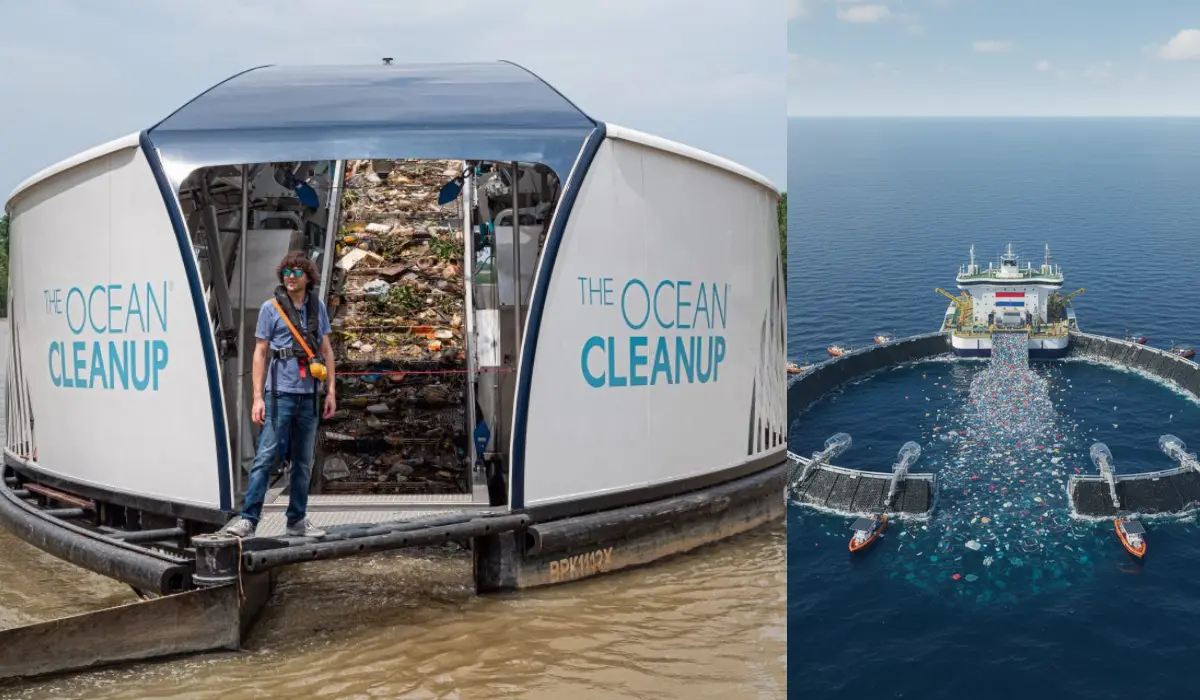
Since then, the organization has moved from small-scale experiments to large-scale operations. Their current system, System 03, spans nearly two kilometers in length and can capture several tons of plastic per sweep.
The cleanup process is continuous: collected plastic is brought ashore, sorted, and recycled into new products, including sunglasses, a symbolic nod to turning waste into something useful.
But Slat’s vision extends beyond ocean gyres. He realized that stopping plastic at the source, rivers, was crucial to long-term success.
In 2019, The Ocean Cleanup launched The Interceptor, a solar-powered system designed to extract trash from rivers before it reaches the ocean. As of 2025, Interceptors are operating in rivers across Asia, Africa, and the Americas, removing thousands of tons of waste every year.
The Impact So Far
By combining high-tech engineering with environmental purpose, The Ocean Cleanup has collected over 10 million kilograms of plastic from oceans and rivers.
The organization’s open data and transparent reporting have helped rally public support and encourage global awareness of the plastic pollution crisis.
More importantly, Slat’s project has sparked a cultural shift. It’s no longer just about “raising awareness,” it’s about action, measurable results, and scalable solutions.
He’s shown that private innovation can complement government and nonprofit efforts in tackling massive environmental problems.
Challenges and Criticism
Despite the progress, the project isn’t without challenges. Critics argue that focusing on ocean cleanup might distract from preventing plastic waste at its source, manufacturing and consumption. Others worry about the environmental footprint of operating large systems in the open sea.
Slat acknowledges these concerns but maintains that the solution requires a two-pronged approach: interception and cleanup. “We need to stop the inflow and clean up what’s already out there,” he’s often said. “Both are essential if we’re serious about restoring the oceans.”
The Bigger Picture
What makes Boyan Slat’s story stand out isn’t just the technology, it’s the persistence behind it. He represents a new generation of entrepreneurs who see business, engineering, and environmentalism not as separate paths but as parts of a single ecosystem of problem-solving.
His journey from a student with a sketch to the head of a global environmental initiative is proof that innovation can be both profitable and purposeful.
In a world where environmental problems often feel too big to solve, Slat’s work offers a rare combination of hope and results. He’s not waiting for governments to act or for consumers to change overnight. He’s building tools that clean the oceans now, one system, one river, one ton of plastic at a time.
A Vision for a Plastic-Free Future
Boyan Slat’s ultimate goal is as clear as the oceans he’s trying to restore: to remove 90% of floating plastic from the seas by 2040. It’s an audacious target, but if history is any guide, he’s not the type to be intimidated by scale.
From a teenager’s frustration underwater to a global movement above it, Slat’s story is a reminder that even one determined person can make waves, and maybe, just maybe, clean up the mess we’ve made.