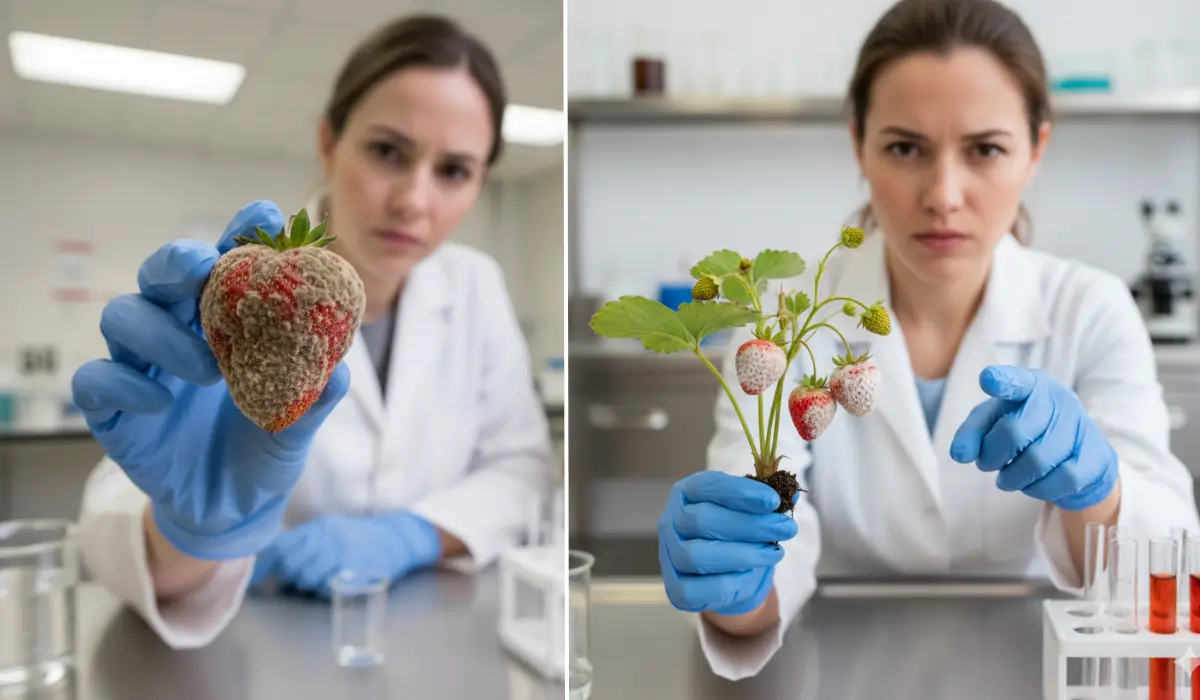
When I first started growing strawberries, I underestimated just how fragile they are. They look tough enough, sending out runners and filling a patch quickly, but strawberries are magnets for disease.
A single infection, if ignored, can spread like wildfire and take down an entire crop in a matter of weeks.
Over the years, I’ve learned to identify the most destructive strawberry diseases and how to get ahead of them before they wipe out months of work.
1. Gray Mold (Botrytis cinerea)
Gray mold is one of the most common but also one of the most devastating diseases I’ve faced in my strawberry fields. It thrives in cool, damp conditions, especially during rainy springs or when the canopy stays wet for too long.
The fungus usually attacks flowers first, turning petals brown and mushy, and then moves on to the fruit. By the time you spot that fuzzy gray coating on berries, the infection has already spread further than you realize.
The real danger is how fast gray mold can ruin a harvest. Perfectly healthy-looking fruit can collapse overnight, leaving soft, unmarketable mush.
I’ve seen entire rows of strawberries rendered useless just as they reached peak ripeness. Once it sets in, there’s no reversing the damage on those berries. All I can do is try to stop it from spreading.
Prevention is my best weapon here. I prune regularly to improve airflow, pick ripe berries daily, and remove any infected fruit immediately.
I also rotate fungicides to avoid resistance and keep the plants dry by watering at the base instead of overhead. It’s all about breaking the cycle of moisture and spores. Gray mold is ruthless, but with vigilance, I can keep it in check.
2. Powdery Mildew
Powdery mildew is a different kind of threat because it doesn’t need wet conditions to spread, it actually thrives in warm, dry environments with poor ventilation.
I often notice it first as a faint white coating on the underside of young leaves, almost like someone dusted them with flour. If ignored, that powdery film thickens, the leaves curl up, and the plant weakens.
The problem with powdery mildew isn’t just cosmetic. Infected plants put their energy into fighting the disease instead of producing fruit.
Leaves curl, photosynthesis drops, and the berries suffer in size and sweetness. In bad outbreaks, entire patches look pale and stunted, and yields take a noticeable hit.
This disease chips away at productivity, and if you grow commercially, that means lost income.
To stay ahead of it, I start with resistant varieties whenever possible. I also make sure plants are spaced properly so air can circulate through the canopy.
When conditions favor mildew, I use sulfur or organic sprays as a preventive measure rather than waiting for visible outbreaks. In strawberries, powdery mildew is manageable, but only if I treat it seriously from the start.
Also Read: What Will Happen If We Ignore the Threat of Bunchy Top Virus to Global Food Security?
3. Anthracnose Crown Rot
Anthracnose crown rot is the disease that keeps me up at night. It doesn’t always announce itself loudly at first, you might just see a plant wilting here and there.
But when I pull those plants out, the crown is dark, mushy, and rotted through. By then, it’s too late. Anthracnose can wipe out entire beds, especially in warm, wet conditions, and once it’s in the crown, the plant is finished.
What makes anthracnose so destructive is its speed. Infected plants often collapse suddenly, leaving gaping holes in otherwise healthy rows.
On the fruit, it shows up as black, sunken lesions that ruin marketability. The disease is highly contagious, and because it’s soilborne, once it’s in a patch, it lingers.
The only real defense is prevention. I always plant with certified disease-free stock and avoid replanting strawberries in the same soil year after year.
Good drainage is critical because anthracnose thrives in soggy conditions. If I suspect an outbreak, I pull infected plants immediately and rotate fungicides as a backup. With crown rot, hesitation equals disaster.
4. Verticillium Wilt
Verticillium wilt is a soilborne fungus that I’ve learned to respect deeply. Its spores can survive in the soil for over a decade, even without strawberries present.
Once it infects a plant, there’s no cure. I usually see it first as stunted growth, one-sided yellowing on leaves, and eventually a slow decline of the entire plant.
Unlike anthracnose, it doesn’t wipe out a crop overnight, but it drags yields down season after season.
The sneaky part of Verticillium wilt is that it doesn’t spread uniformly. Some plants look healthy while others collapse nearby. It’s easy to underestimate the problem until the losses start adding up.
This disease is especially tough if you’ve rotated with crops like tomatoes, peppers, or potatoes, which are also hosts, and they keep the fungus thriving in the soil.
My strategy against Verticillium is all about long-term soil health. I rotate with non-host crops, use resistant strawberry varieties, and sometimes even solarize the soil in summer to kill spores with heat.
Once Verticillium establishes itself, it’s nearly impossible to eliminate. The key is never letting it get a foothold in the first place.
5. Leaf Spot Diseases
Leaf spot diseases, such as common leaf spot and leaf blight, may seem minor compared to crown rot or wilt, but I’ve learned not to underestimate them.
They’re caused by fungi that love wet leaves and humid weather. The first signs are tiny purple spots that spread and merge into larger brown lesions, eventually making the leaves brittle and weak.
The impact is indirect but serious. When leaf spots spread, the plant loses photosynthetic power. That means weaker growth, fewer flowers, and smaller fruit.
The berries themselves may survive, but the overall productivity of the patch takes a big hit. If you grow strawberries for sale, leaf spot can slash your yields in half if left untreated.
I fight leaf spot with a combination of sanitation and prevention. I remove old leaves and plant debris, switch to drip irrigation instead of overhead watering, and apply fungicides if the infection pressure is high.
Good airflow helps too, since dry leaves are less likely to host fungal spores. Leaf spot is one of those “silent yield killers” that sneaks up unless I stay ahead of it.
6. Red Stele Root Rot
Red stele is a root disease caused by Phytophthora fragariae, and I’ve seen it destroy whole fields under the right conditions. It thrives in poorly drained soils where water lingers around the roots.
The infected plants look stunted and wilted, especially after rain, but the real giveaway is underground: when I split the root, the central core is red or brown instead of white.
The challenge with red stele is that it spreads invisibly in wet soil. By the time symptoms appear, the disease is often well established.
Entire sections of the patch may weaken at once, and yields drop sharply. In wet seasons, it feels like an unstoppable wave.
I’ve learned that drainage is everything when it comes to red stele. I build raised beds, improve soil structure, and avoid planting strawberries in low-lying areas.
Resistant varieties and fungicide drenches can help, but nothing beats prevention. Once the red stele settles in, the soil becomes hostile to strawberries for years.
Also Read: Don’t Let Carrot Fly Ruin Your Harvest: Here are Some Effective Ways to Protect Your Plants
Integrated Disease Management
One thing I’ve learned after years of battling strawberry diseases is that no single tactic works alone. Fungicides, resistant varieties, good sanitation, and soil health all have to work together.
The growers who succeed aren’t just reacting to problems, they’re preventing them with a system that reduces risk at every step.
For me, that means starting with certified disease-free plants, spacing them for airflow, and managing water carefully so the soil and leaves don’t stay wet.
I rotate crops religiously, test my soil, and remove diseased plants as soon as I see them. I also lean on biological controls where possible, such as beneficial microbes that compete with pathogens.
When disease pressure builds, I don’t hesitate to use fungicides, but I always rotate modes of action to prevent resistance. The mindset I’ve developed is proactive rather than reactive.
Once a disease takes hold, options shrink. By staying ahead of the curve, I protect both my crop and my bottom line.
FAQs
Yes, especially when paired with resistant varieties, good drainage, and strict sanitation. Soil testing or plant bioassays are the only reliable ways to confirm its presence. Start with certified disease-free plants and give them enough space for airflow. Is organic disease control effective for strawberries?
How do I know if my soil carries Verticillium wilt?
What’s the single best preventive step I can take against strawberry diseases?