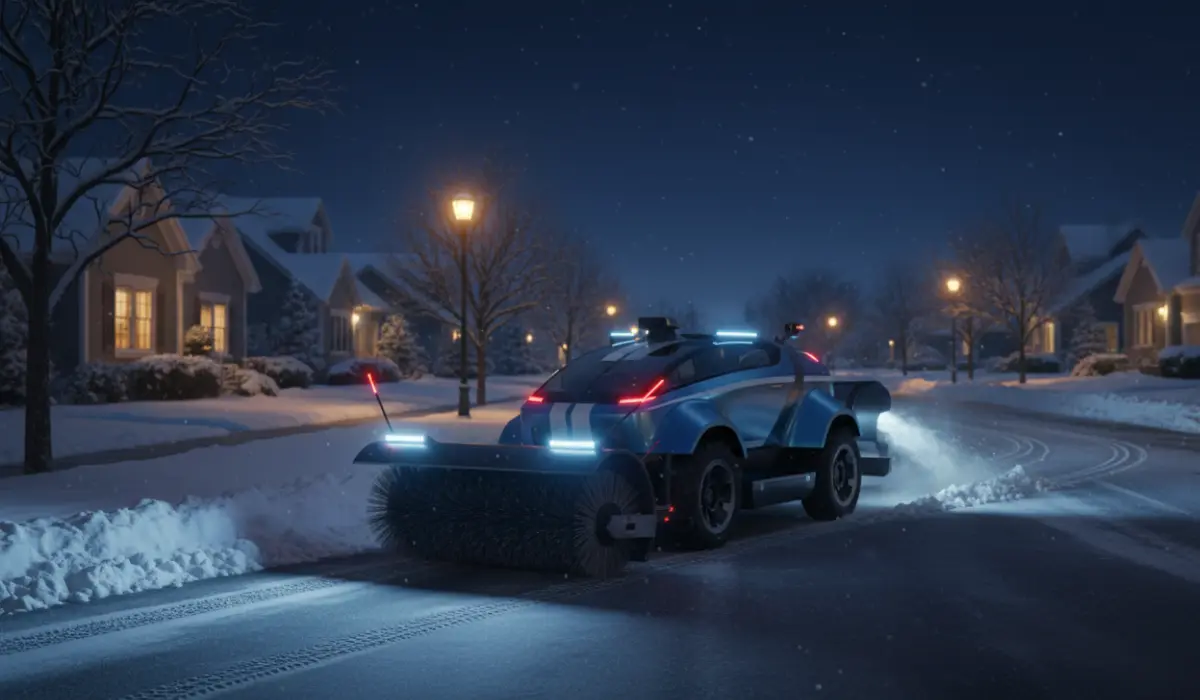
Winter’s burden, snow and ice on sidewalks and pedestrian routes, is a major maintenance challenge in cold-weather regions. Traditional methods rely on fuel-powered plows, salt spreaders, and manual labour, with associated costs, emissions, and noise.
In a forward-looking move, Transport Canada has partnered with a home-grown innovator to trial a robot that aims to change that equation.
From concept to trial
In March 2022, Transport Canada announced that it is testing the world’s first electric, semi-autonomous sidewalk snowplow and salting robot from Swap Robotics. tc.canada.ca+1 Under the contract (≈ CAD $172,000), the robot was deployed at the Transport Canada Innovation Centre site at Tunney’s Pasture in Ottawa, over the winter of February–mid-March. tc.canada.ca+2nationalobserver.com+2
The vehicle is described as fully battery electric, with no internal-combustion engine, and equipped for both snow-ploughing and salt-spreading operations on sidewalks (rather than highways).
According to TC, it moves on six wheels, uses lights and audible backup sounds, and employs cameras and computer vision to identify obstacles such as people, pets, and bicycles. tc.canada.ca
Advantages in a new territory
The robot test addresses several interlocking goals:
- Zero local emissions: Battery operation means no tailpipe exhaust, which supports clean technology and climate commitments. (TC emphasises “clean technology” batteries.) tc.canada.ca+1
- Quieter operation: The robot is much quieter than conventional snow-plows, which is a major plus for dense urban areas, early-morning or night-time work where noise is a concern. tc.canada.ca
- Labour relief: Seasonal snow clearing often involves short-term manual labour, sometimes in harsh conditions; automating parts of that can help municipalities facing labour shortages. tc.canada.ca+1
- Urban-sidewalk focus: Unlike road-plows designed for wide streets, this robot is focused on sidewalks and pedestrian infrastructure, a niche often neglected in automation efforts.
- “Teach-and-repeat” autonomous mode: According to TC’s summary, the robot learns the desired route and then autonomously repeats it under supervision. tc.canada.ca
Trial findings and real-world performance
The trial at Tunney’s Pasture covered a 1.7 km route of sidewalks and campus walkways. The robots handled multiple snow events under supervision, with no reported major safety or operational incidents. tc.canada.ca+1
TC said the tests gave its teams “an opportunity to be close to the work and to be able to input to it, while providing Swap the opportunity to receive feedback and technical advice.” tc.canada.ca
However, TC emphasises that deployment on city streets will require “concrete evidence and measurable standards” to ensure the technology performs safely and efficiently under varied conditions. tc.canada.ca
Moving toward wider rollout
After the Ottawa trial, the next steps include further testing at locations such as Carleton University campus, where the robot will be field-tested in another real-world context. tc.canada.ca+1
Broader adoption faces a number of considerations: municipal budgets, integration with existing maintenance fleets, certification for pedestrian-sidewalk interactions, and reliability under heavier snow loads or extreme weather.
An analysis article in the National Observer (January 2024) points out that while the results are promising, the technology still needs to prove cost-effectiveness and robustness to scale. nationalobserver.com
Why this matters
The project represents a convergence of several trends: electrification of municipal fleets, automation in public-works operations, and new forms of servicing infrastructure (sidewalks & pedestrian routes rather than roads).
For municipalities in cold climates, any technology that can reduce emissions, noise, labour costs, and increase responsiveness could be a valuable tool.
Moreover, the trial is illustrative of how a federal department (Transport Canada) can act as an innovation partner: by awarding a pilot contract to a startup (Swap Robotics), supplying a real-world site, and helping define standards for future regulation. As TC put it:
“All sorts of projections suggest we are going to see more and more types of robots on the sidewalks… now we know it is coming, and we have a sense of how to respond.” tc.canada.ca
Challenges ahead
- Safety and pedestrian interaction: Sidewalks are dynamic spaces; robots must reliably detect children, pets, bikes, delivery carts, and unexpected obstacles.
- Weather robustness: Canadian winters can be severe; ploughing heavy, wet snow or dealing with ice and compacted snow poses serious mechanical and power-management demands.
- Cost-benefit justification: Municipal budgets are tight; any new investment must show a return in labour savings, reduced maintenance, lower consumables (salt), or avoided overtime costs.
- Scaling and standardisation: From one 1.7 km campus route to kilometres of sidewalks across a city requires scalability, fleet management, scheduling systems, maintenance support, and spare parts supply.
- Regulatory / liability frameworks: Autonomous machines operating in public pedestrian areas bring questions of responsibility in case of failure or incident.