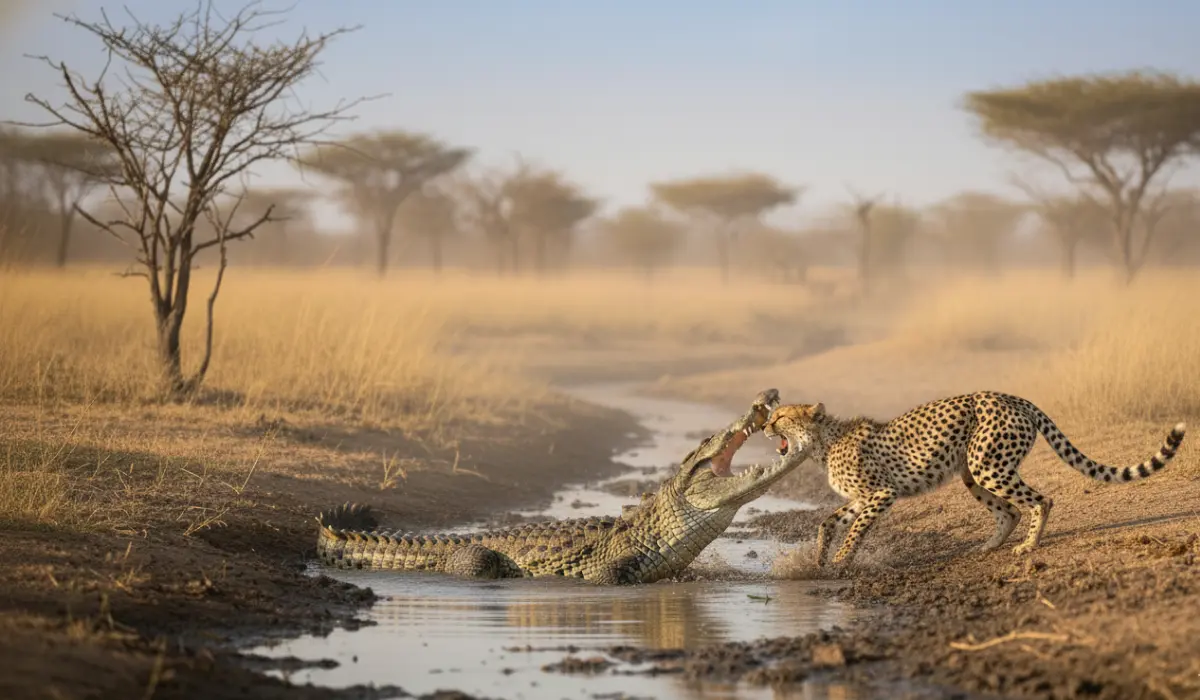
In the wild, even the fastest predator isn’t always the strongest. The cheetah, built for speed and agility, rules the savannas when it comes to sprinting down gazelles.
But drop that same animal near a riverbank, and it’s suddenly out of its element. When a crocodile surfaces, the cheetah’s incredible athleticism and grace mean very little.
The question is simple: why are cheetahs so defenseless against crocodile attacks? The answer lies in their biology, behavior, and the very design of their survival strategy.
1. Built for Speed, Not for Battle
The cheetah’s entire body is engineered for one purpose, speed. Everything about its anatomy screams lightweight efficiency. Its spine is ultra-flexible, its legs are long and lean, its head is small, and its muscles are tuned for rapid acceleration rather than raw strength. A cheetah can go from zero to sixty miles per hour in just a few seconds, but that comes with trade-offs.
Crocodiles, on the other hand, are armored tanks. Their bodies are dense, their muscles powerful, and their hides thick with scales that can resist serious impact.
They are ambush predators, built for explosive bursts of power over short distances, especially in water. When these two creatures meet, the cheetah’s speed advantage disappears. In water, speed doesn’t save you. Power does.
Also Read: How to Rescue Your Cattle From an Anaconda Attack
2. Poor Swimmers in the Crocodile’s Domain
Cheetahs avoid water for a reason, they’re not natural swimmers. Their long, slender legs and light build make them excellent on land but awkward in rivers. They lack the muscle mass and webbing that help other big cats like tigers or jaguars swim effectively.
Crocodiles, meanwhile, are aquatic masters. They can hold their breath for up to an hour, glide silently beneath the surface, and strike from below without warning.
When a cheetah approaches the water’s edge to drink, it steps into enemy territory. One quick lunge from a crocodile can end the encounter before the cheetah even sees the threat.
There’s no escape route, no acceleration lane, just water and teeth.

3. No Defensive Arsenal
Big cats like lions and leopards have one major advantage that cheetahs don’t: powerful builds and fighting ability. A lion can fend off a crocodile or at least put up a fight. Leopards, though smaller, are stocky and muscular enough to climb trees or defend themselves.
Cheetahs, by contrast, have small jaws, light frames, and semi-retractable claws optimized for traction, not combat. They rely on stealth and chase, not confrontation.
Their claws can’t deliver deep slashing wounds, and their bite strength is relatively weak compared to other big cats. When threatened, a cheetah’s best move is to run, but against a crocodile in water, that instinct doesn’t work.
Even on land, if a crocodile managed to grab a cheetah by surprise, there’s little the cheetah could do to fight back. Its bones are light and fragile by predator standards; a crocodile’s death roll would crush them easily.
4. Behavioral Vulnerabilities
Cheetahs are cautious, but their survival depends on hydration and open grasslands. In hot environments like the Serengeti or Maasai Mara, rivers and watering holes are essential. These spots are also prime hunting grounds for crocodiles.
Unlike pack hunters such as lions, cheetahs are mostly solitary or found in small groups called coalitions (usually males). That means no backup, no coordinated defense. A lone cheetah drinking at a riverbank is an easy mark.
Additionally, cheetahs have evolved to minimize conflict at all costs. They avoid fights even with smaller predators like hyenas or jackals because any injury, no matter how minor, can be fatal.
A limping cheetah can’t hunt, and if it can’t hunt, it can’t live. So in a crocodile encounter, the cheetah’s instinct is avoidance, not resistance.
Also Read: Can a Mongoose Defeat a King Cobra in a One-on-One Face Off?
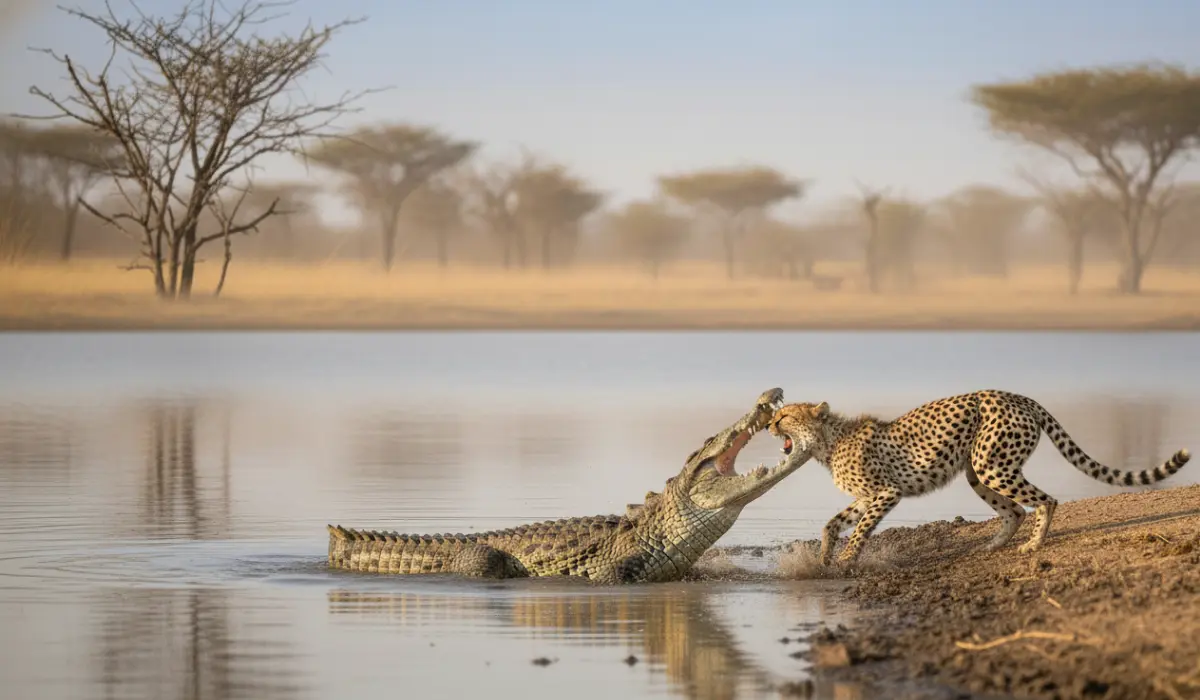
Each Predator Has Its Place
It might seem unfair that an apex land predator like the cheetah is helpless against a reptile, but that’s how ecosystems work. Every animal is perfectly adapted to its niche.
The cheetah’s world is the open plain, where its vision, acceleration, and precision hunting dominate. The crocodile’s world is the water, where ambush, stealth, and raw power rule.
Each predator’s strength becomes a weakness outside its element. The cheetah’s speed is useless in the water; the crocodile’s bulk is a disadvantage on dry land. When their paths cross, the terrain decides who wins. And near rivers, it’s always the crocodile’s domain.
Bottom Line
Cheetahs are not defenseless because they are weak, they’re defenseless against crocodiles because they were never designed for that kind of fight.
Their speed, grace, and precision make them champions of the chase, but also leave them fragile and ill-equipped for sudden, brute-force attacks from the water.
In the animal kingdom, specialization comes with sacrifice. The cheetah traded armor for agility, claws for traction, and strength for speed. Against a crocodile, those trades are costly. It’s not a failure of evolution, it’s the price of perfection in a world where every predator has its limits.